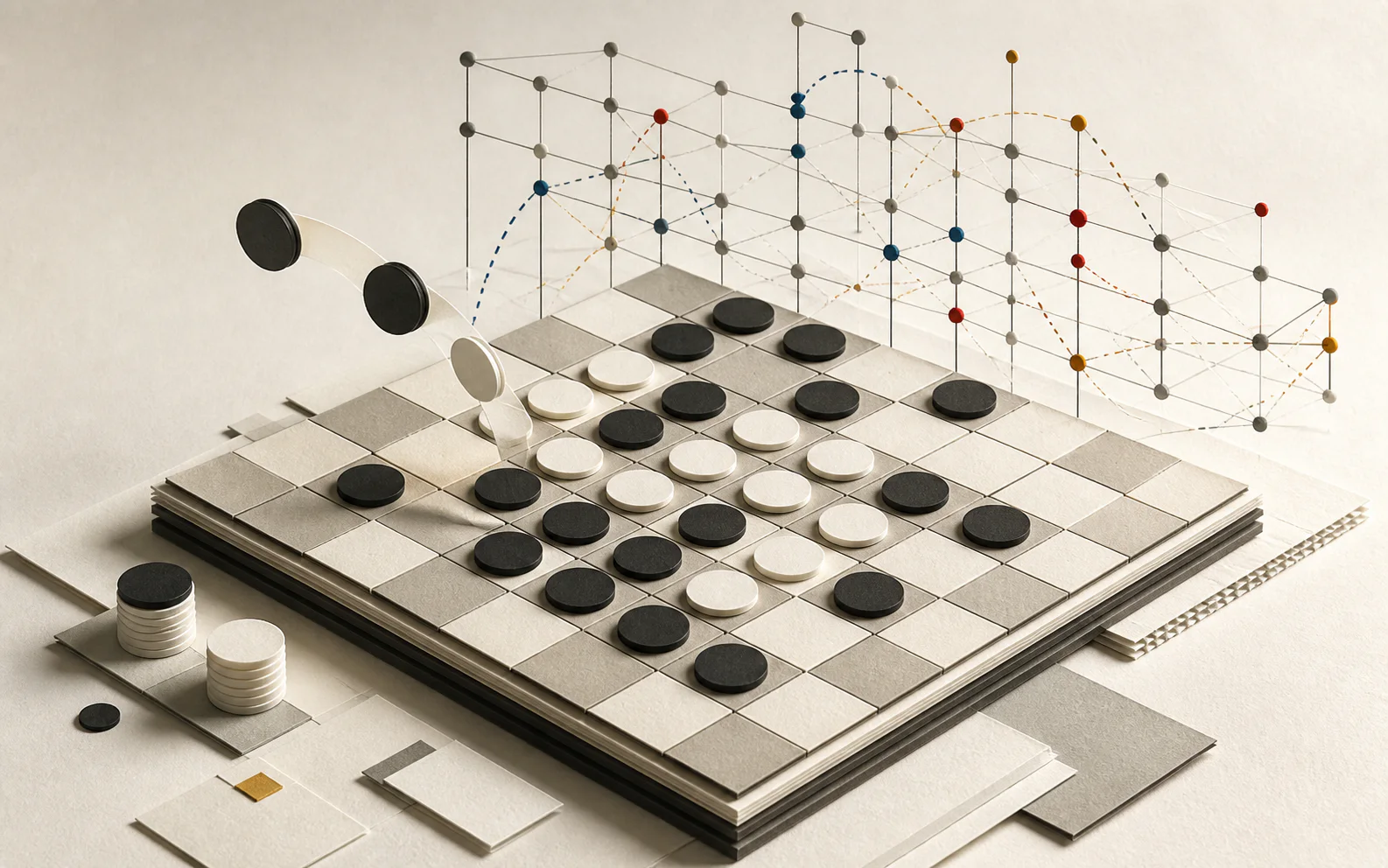
The third run · 35 experiments · about 4 hours
Then I asked it to win
Playing by the rules is a low bar. A model can make only legal moves and still play badly, handing the game away move after move. So for the third run I raised the stakes to the thing I'd wanted all along: win the game, not just finish it legally.
Under the hood: keeping score of skill
To measure skill you need opponents. So I built a fixed ladder of four, from easy to hard: a player that moves at random, a greedy one that grabs the most pieces every turn, and two that think ahead, searching one and two moves into the future. The model plays a set batch of games against each, and its score is simple:
strength = wins + ½ · drawsgames played
averaged across the four fixed opponents. 0.5 against an opponent is an even match; above 0.5 it wins more than it loses.
The opponents, the number of games, and the starting positions are all locked down, so the agent can't cheat the number with a lucky streak. And "play" means just what it sounds like: the model looks at the game so far and, of the moves that are actually legal, makes the one it rates highest. No search, no rulebook, no looking ahead, only the instincts it built from watching finished games.
Same loop as before: a fresh idea, five minutes of training, keep it only if the score clearly rose. Each dot is one experiment; the line tracks its best score so far.
It climbed from barely above a coin-flip to genuinely skilled play. Graded afterward on a larger, fully deterministic set of games, the final model wins convincingly against the easier opponents:
88%
of games won against random play
76%
won against a greedy piece-grabber
90%
won against a one-move-lookahead search
That is real skill, learned from nothing but lists of moves, with no rules given and no searching ahead when it plays. It meets its match against an opponent that looks two moves ahead, and a deeper search still beats it, since the model never learned to plan that far. But reaching the level of a searching player on instinct alone is a lot for so small a network.
Two changes drove most of the gains, and both were about restraint. The agent made the model smaller, trimming it to four layers, and added dropout, which forces it not to lean too hard on any single detail. With so few training games to learn from, a bigger model just memorized them; a leaner one had to pick up the general shape of good play instead. The champion ended up at about 3.5 million parameters, a twelfth the size of the second run's model, yet a far stronger player.
And the single biggest jump? An old friend. That same board-symmetry trick from the first run, the one the second run threw away, paid off again here, the largest single win of the night. The first run embraced it, the second discarded it, the third welcomed it back. The same idea, a third verdict, decided each time by nothing but the goal I had set.