Folding paper onto a cube
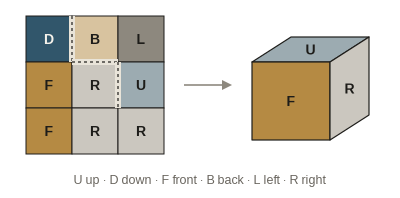
What I came up with was a 41-page proof that answers part of an open question from a 2025 paper, about wrapping a cube in a sheet of paper squares. No expert has read it yet, but I've sent it out for review.
The experiment
Could I direct a discovery?
I have a math minor, took advanced calc, diff eq, linear algebra, but I am not a mathematician. I wanted to know whether I could pick an open question, point AI models at it, and come back with something new.
Through my prompting, AIs wrote it and a different AI checked it.
The models are good at mathematics now. What I wanted to find out was narrower: could someone who is not a mathematician choose a problem, steer the work, and end up with a result that is both new and true?
The problem I settled on comes from a 2025 paper by Oswin Aichholzer, Florian Lehner and Christian Lindorfer, Folding polyominoes into cubes. It suited the experiment for three reasons. It can be stated without any mathematics. The paper leaves it open. And small cases can be checked by a computer trying every possibility, so a claim can be tested without trusting whoever made it.
The division of labor was simple. The models did the mathematics: every proof, every program, every check. My job was to choose the question, to keep asking whether each claim was really proved, to decide who checked whom, and to decide what was fit to publish.
The puzzle
Wrap a cube in a sheet of squares
Take a flat sheet made of squares, like a sheet of postage stamps, and a cube whose sides are each the size of one square. The sheet may already have slits cut along the lines between squares, as long as it is still in one piece. You may not cut it further, and you may not glue anything.
You fold only along the lines between squares, and every such line gets one of two folds.
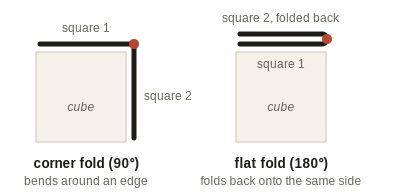
Squares may pile up in layers on the same side of the cube. The paper may never pass through itself. The goal is to cover all six sides.
The question
Ghost paper and real paper
Suppose someone hands you a sprawling sheet of 50 squares and asks whether it wraps the cube. There are really two questions.
- The ghost test. Pretend the paper is a ghost that can pass through itself. Can you fold it so that at least one square lands on each of the six sides?
- The real-paper test. Can you do it with real paper, with every layer tucked over or under the others, so that nothing has to pass through anything else?
A folding plan can pass the ghost test and still fail with real paper.
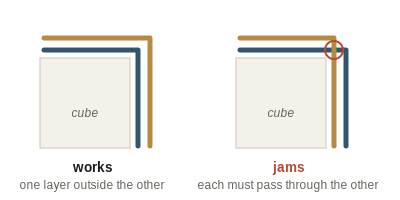
So the three researchers asked: if a sheet passes the ghost test, can it always be folded for real? Or is there a sheet where every ghost folding jams, so that it can never wrap the cube? They also predicted that a computer should be able to decide whether a sheet wraps the cube without trying an exploding number of combinations.
The claim
For sheets without holes, the ghost test is enough
The claimed result settles both points for every sheet without holes.
- If a sheet without holes passes the ghost test, it can be folded for real. One folding plan may jam, but there is always another way to fold the same sheet that covers all six sides cleanly.
- A computer can decide it efficiently. The work grows steadily as the sheet gets bigger, instead of doubling with every added square.
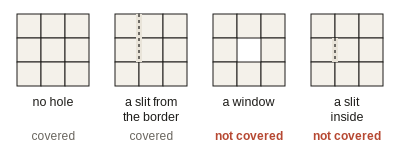
A hole is a window cut out of the middle, or a slit that lies entirely inside the sheet. A slit that starts at the border is fine.
- 41pages in the proof
- 87,538cases checked by computer
- 7lines of corner folds are always enough
- 0experts have checked it so far
How the proof goes
Why it works, in three steps
Proving something about every possible sheet sounds hopeless, since a sheet could have a million squares. The proof shows that only the corner folds matter, and that very few are needed.
Step 1. At most 12 lines of corner folds. A flat fold keeps the paper on the same side of the cube. Only a corner fold moves it to a new side. Corner folds line up: each one belongs to a straight line of corner folds that runs across the sheet from border to border. On a sheet without holes, every such line splits the sheet in two. So the lines divide the sheet into patches, and each patch ends up entirely on one side of the cube.
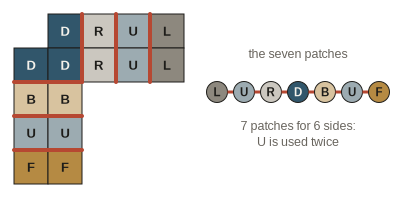
A line can be switched from corner folds to flat folds, which merges the two patches beside it. The proof shows that after switching every line you can spare, at most 12 remain.
Step 2. A computer check brings 12 down to 7. With at most 12 lines there are few enough arrangements of patches to list them all: 87,538 cases. For each one, a computer program confirms that more lines can be switched, down to 7 or fewer, with all six sides still covered.
So the whole sheet, however large, is divided into at most eight patches: six to cover the six sides, and at most two extra.
Step 3. Fold up each patch and nest the stacks. Inside a patch there are only flat folds, so the patch folds up, back and forth like a road map, into one stack on one side of the cube. Where two patches meet along an edge of the cube, one stack has to wrap around the other. Because at most two patches are extra, there are only a handful of ways the stacks can meet, and the proof goes through each one. This is the longest and most delicate part.
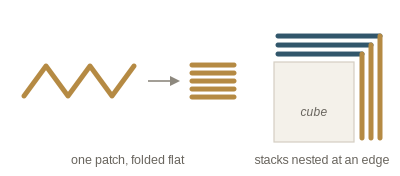
The limit of seven lines is also what makes the computer method work. The program does not try every way to fold every square. It looks only at the straight lines that run across the sheet and tries groups of up to seven of them.
Where it stops
Why holes are harder
Picture a sheet shaped like a picture frame. A line of folds across one side of the frame no longer splits it in two, so step 1 breaks down. And there is a second problem.
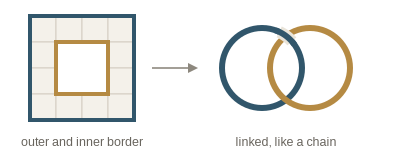
For sheets with holes the original question is still open. Nobody knows a sheet with holes that passes the ghost test but cannot be folded. In this project, every one of about 39,000 small sheets with holes that passed the ghost test did fold. But a search is not a proof.
How it went
Twenty-four days, four models, and a lot of being wrong
The work was done by four models from three companies: Anthropic's Fable 5.2 and Opus 5.5, Google's Carbon, and OpenAI's Astra. By the end the project folder held more than 600 research notes, 900 programs and 3,000 result files.
- 21 OctWork begins
- Late OctHundreds of notes and big claims, including claims about sheets with holes
- 5 NovFirst full proof for sheets without holes
- 6 NovA check finds a false step; it is replaced the next day
- 9 NovA full review finds that the big claims about holes are not proved
- 13 NovA different AI model audits everything
- 14 NovMade public, and sent to one of the researchers who asked the question
The project, from the first files to the day it went public. The two red entries are the times a check found that something claimed as proved was not.
What I learned is mostly about checking.
The models announce theorems easily. Within days the notes were full of the words "proved" and "complete", for much more than the result above, including sheets with holes. Producing confident mathematics turned out to be the easy part.
The first full proof had a false step in it. The first complete draft is dated 5 November. The next day a check found that one of its supporting statements was simply false: a block of four squares was enough to show it. That section was thrown out and replaced, a day later, by a different argument.
The bigger claims did not survive. On 9 November a review of the whole project found that the largest "theorems" about sheets with holes rested on steps nobody had actually proved. Those are withdrawn. The project's records now say, claim by claim, what is withdrawn, what depends on an unproved step, and what stands.
Then I had a different model audit everything. I gave a copy of the project to a different model, with instructions to form its own view before reading any earlier review and to trust no count or "verified" it had not checked itself. It rebuilt the 87,538-case check with its own program and found no error in the proof. It did find mistakes in the supporting notes and in how some checks were described. Its own report had mistakes too, including quotations that were not in the files, and a check of the audit caught those.
No single link in that chain is reliable. What I trust, as far as I trust it, is the structure: separate programs that recompute the same numbers, reviewers told to break things, an audit by a different model, and brute-force searches over small sheets that would have exposed a wrong answer.
On 14 November I made the result public and sent it to one of the researchers who posed the question.
How far to trust it
So, is it a discovery?
I don't know yet, but the AI reviews put their confidence that the result is new at about 90–96%.
- What has been checked. Separate AI sessions re-read the argument step by step several times. A different model audited it and re-ran the computer check with its own program. On about 11,500 small sheets the result agrees with software written by other researchers for the same problem, once two defects in that software were corrected. Searches through tens of thousands of further sheets found no counterexample.
- What those checks cannot show. In small sheets, almost every ghost folding already works with real paper, so tests on small sheets rarely reach the hard case. And every checker so far was an AI, which may share blind spots with the AIs that wrote the proof.
- What would settle it. A specialist reading the proof. I have asked.
Everything needed to check it is public. If you can find a sheet that breaks it, or a step that does not hold, I would like to hear.
In short
I picked an open question, and AI models produced a 41-page proof that answers it for sheets without holes, along with a program that checks the one step done by computer. Getting there meant throwing out a false step and withdrawing the more ambitious claims. Whether it is right is now a question for people who can read it.